
Current status: pending formal adoption at institutional level. In principle support from 1W nursing staff and Orthopaedic consultant group.
Orthopaedic external fixators are commonly used for trauma and elective indications. Inherent in the design of an external fixator are pins that enter bone from outside the body. This presents an area at risk of infection, as the pins are exposed to the outside world. Pin site care regimes are designed to reduce the risk of infected pin sites.
Trauma external fixators are usually temporary, planned to be in place for 1-2 weeks and consist of large (5-6mm) half pins or transfixing pins (through the calcaneus/heel bone). Fine wire frames (also known as Ilizarov frames, circular frames, or Taylor Spatial Frames) are also commonly used for definitive trauma fixation or deformity correction – where they may be in place for 3 to 18 months. These use a combination of fine wires (~2mm) and standard half-pins (5-6 mm).
Literature reviews demonstrate that no universally accepted pin site care regimes exist. There is some evidence that antimicrobial dressings (e.g. those impregnated with silver or chlorhexidine) may reduce infection rates (Shields, 2022)
Pin site dressing regimes involve cleansing the pin site area and application of dressings at the skin-pin interface. This interface often forms a crust of dried blood and inflammatory tissue. Removal of this crust during pin site care has been associated with increased rates of infection (Britten, 2013).
Ensuring consistent instructions breeds familiarity and maintains a consistent standard of care, reducing errors.
Once pin sites have developed a mature crust, dressing may not be necessary for those with long term frames.
2. Applicability
This guideline is applicable to all nursing and medical staff looking after patients with external fixators. This includes all Western health sites, particularly inpatient services at Footscray, Williamstown, Sunshine/Joan Kirner and the relevant outpatient clinics.
This does not apply to isolated finger external fixators, or patients with suspected or confirmed allergies to silver.
3. Responsibility
Doctors within the orthopaedic unit and nursing staff on wards looking after orthopaedic patients should be familiar with this guideline. Implementation of this guideline should be triggered whenever a patient with and external fixator is admitted to a ward.
4. Authority
Exceptions to this guideline can be made by orthopaedic registrars, following discussion with the consultant surgeon on call, or responsible for the care of the individual patient.
5. Associated Documentation
In support of this guideline, the following Manuals, Policies, Instructions and/or Guidelines apply:
| Name |
| PPG title/relevant document or form (press ‘tab’ to add more rows) |
6. Credentialing Requirements
No formal credentialing requirements are in place for implementation, as the guidelines involve relatively routine parts of patient care for all surgical medical and nursing staff.
7. Definitions and Abbreviations
Include here all definitions of terms or abbreviations used in the guideline. It is preferable that pre-existing definitions are used.
7.1 Definitions
For purposes of this guideline, unless otherwise stated, the following definitions shall apply:
| External fixator | A device used to hold bones involving pins that traverse from outside of the skin into the bone |
| Pin site | The interface between skin and pins that traverse the skin to fix bone |
8. Guideline Detail
Standard pin site care
Weekly pin site care should take place, with increasing frequency if dressings are soaked, or there are concerns for infection.
Once mature skin has formed at a pin site (for elective or long term frames) routine pin site care may no longer be necessary.
Care should be taken to identify any potentially exposed sharp pins on the external fixator. These should be covered by the operative surgeon during frame application, however; caps can fall off and should be replaced and secured with tape prior to pin site care.
Equipment required:
- Nonsterile gloves & sterile gloves
- Dressing pack with cotton buds
- Normal saline
- Silver hexagon dressings (one hexagon per pin site)
- ACTICOAT EXFIX (Smith & Nephew) or equivalent

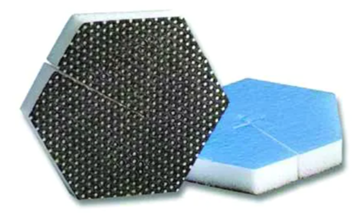
Pin site care procedure:
- Perform hand hygiene
- Open sterile stock and pour saline into tray
- Using non-sterile gloves, remove current dressings and any bandages overlying
- Assess for signs of infection
- Repeat hand hygiene and apply sterile gloves
- Using a single saline-soaked cotton bud per pin site, cleanse the area gently to remove any excess blood or debris
- No attempt is made to remove crusted skin from the pin-skin interface
- Apply a single silver hexagon to each pin site, ensuring the pin sits in the axilla of the hexagon
- Ensure the silver side is facing the skin, blue side facing away from patient
- The dressing should be sitting on the skin and it may be necessary to secure it to the skin with a piece of tape or dressing (e.g. Fixomull Stretch – Leukoplast)
- Ideally, a rubber bung will be placed on the pin intra-operatively prior to frame assembly which can be moved up and down the pin to secure the dressing
- Pin site care should be documented in patient notes including the time and date to guide next dressing change
Infected pin sites:
- Infections are a relatively common complication of pin sites. Signs and symptoms include: increasing pain, surrounding erythema, weeping from a previously dry pin site, purulent discharge, pin loosening
- Any concerns for pin site infection should be escalated to the orthopaedic doctors (intern, resident, or registrar)
- A timely review should take place (within a few hours) and the orthopaedic registrar should discuss the case with the treating consultant
- Medical staff should have a low threshold to commence oral antibiotics with skin coverage (cefalexin or equivalent)
- Any wound swabs for diagnostic purposes should not delay commencing empirical antibiotics
- Pin site care should be performed second daily in the setting of confirmed or suspected infection
Immediate post operative care:
Dressings placed in theatre:
- If silver hexagon dressing have been placed in theatre, they may be maintained for 7 days prior to pin site care
- Initial non-silver hexagon dressings (e.g. betadine soaked sponge/gauze) placed in theatre should be changed after three days, unless they are soaked through sooner
- Standard silver hexagon dressing should be placed as part of routine pins site care after the first three days
Bleeding Pin sites:
- Pin sites may bleed in the early post-operative period and soaked dressings should be changed according to the above procedure as needed
- An additional layer of absorptive dressing (e.g. gauze or combine dressing) should be placed over the pinsite dressing with some compression applied to the area via circumferential wool (e.g. Velband) & crepe bandage
- Care should be taken to avoid contact with any exposed pin edges that may pose a sharps risk to staff
9. Document History
Work in progress, no formal version history at this stage
10. References
Britten S et al., 2013 Ilizarov fixator pin site care: the role of crusts in the prevention of infection., Injury., doi:10.1016/j.injury.2013.07.001
Shields D, liadis A, Kelly E, Heidari N, & Jamal B. 2022 Pin-site Infection: A systematic review of prevention strategies. Strategies in Trauma and Limb Reconstruction. 17(2) 93-104. 10.5005/jp-journals-10080-1562